
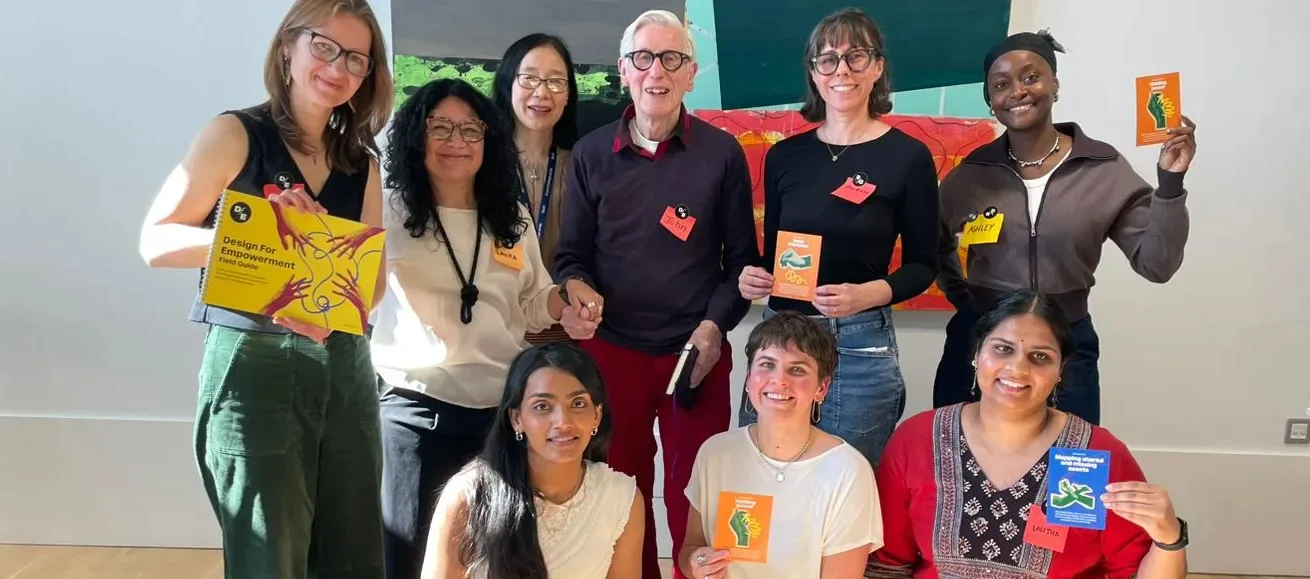
Design for Empowerment · Champions Training Day
Is your participatory process genuinely designed for empowerment, and how would you know?
Come to this one-day, hands-on session for practitioners and educators who want to examine how power shapes their collaborative work and to introduce the Design for Empowerment toolkit within their own settings to map power dynamics, set empowerment aims and evaluate the level of empowerment impact in participatory projects.
Date Friday 4 December 2026
Time 9:30am – 4:30pm
Venue Royal College of Art, Battersea, Hester Road, London SW11 4AN
Cost Free. Lunch and refreshments are included.
Travel support Bursaries of up to £100 for up to 10 external participants
Apply by 26 November 2026, midnight.
APPLICATIONS ARE NOW CLOSED.
Places are limited and allocated through a short application.
Participation is not the same as influence
Many projects promise participation, collaboration or co-design. Yet practitioners and educators are often given little support to examine who defines the problem, whose knowledge carries authority, who controls decisions and resources, or what participants can genuinely influence.
Who should apply
We welcome applications from practitioners and educators working across design and innovation, public and third-sector organisations, cultural institutions, community engagement, research, urban development and social change, including colleagues from the RCA and from other institutions and organisations.
Please bring a current or recent project, or a teaching context, that involves collaboration, participation or stakeholder engagement. We aim to bring together a diversity of disciplines, sectors and organisations, so please tell us about your context and how you expect to use the toolkit.
About the day
Design for Empowerment (DfE) is a research-led framework and toolkit, developed over six years of research and engagement with practitioners in design, public-sector, social-innovation and community contexts. It makes explicit who defines change, how power operates, what ‘empowerment’ is intended to mean and how shifts in agency can be recognised.
The framework is organised around four principles – power analysis, empowerment aims, working through resistance and empowerment narrative methods – and four dimensions of power: power-within, power-to, power-with and power-over.
The day does not prescribe an idealised process or promise that empowerment can be delivered through a toolkit. It offers a structured and confidential space for examining the compromises, constraints and difficult decisions that characterise real collaborative work.
The Champions Training Day brings together a cross-sector group to learn the approach together, and then to introduce it within their own organisations, networks and classrooms.
After the day
Champions are invited to document how they apply DfE – for example through revised briefs, curriculum materials, facilitation plans, workshop records or case examples – and to share brief follow-up reflections over the following months. The DfE online hub will provide a route for doing so.
Evaluation, consent and confidentiality
Taking part in evaluation is voluntary. Separate consent will be sought for evaluation, photographs and quotations, and declining will not affect your participation. Discussions of organisational power can involve professional vulnerability, so the session will work with shared confidentiality agreements and allow anonymous contributions. Findings will be reported in aggregate unless you give permission to be attributed.
Access and practicalities
Please tell us about any access or dietary requirements in your application. Confirmed participants will receive joining instructions covering arrival, building access for visitors external to the RCA, and how to claim travel expenses.
Questions? Contact hello@designforempowerment.net